Stage 01 Manual — Queue & Picking

Orders: From Checkout to Work Queue

A messy morning order queue turns a calm workshop into an obstacle course. When an operator prints orders in simple chronological order, they end up switching between fragile glassware, flat mailers, international customs forms, and out-of-stock queries every three minutes. Good fulfilment starts by sorting the digital queue so your feet and hands repeat the same motion across batches of identical work.

You do not need an enterprise Warehouse Management System (WMS) to impose order. Native tags in Shopify, WooCommerce, or a lightweight shipping aggregator let you filter clean orders from exceptions in under ten minutes each morning.
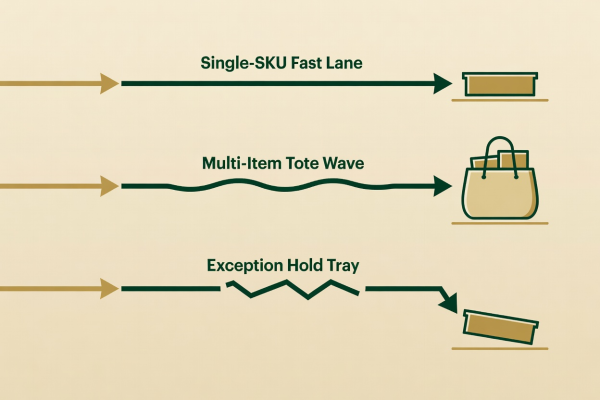
Flat vector diagram in forest green, brass, and parchment showing incoming checkout orders split into Single-SKU Fast Lane, Multi-Item Tote Wave, and Exception Hold Tray

The Four-Bucket Morning Triage

At 08:30, before anyone walks down a shelving aisle, freeze the current dispatch wave at a clear cutoff timestamp and divide unfulfilled orders into four distinct buckets. Never mix these buckets on the same trolley.

Bucket A — Fast Lane

Single-Unit Bestsellers

In most independent online stores, 30% to 45% of daily orders consist of a single unit of a top-ten SKU. Filter these orders first, print their 4×6 shipping labels in one continuous ribbon, bring one bulk crate of that product to the bench, and label-and-bag them in an unbroken rhythm.

Bucket B — Standard Multi-SKU

2 to 6 Line Items

Orders containing multiple distinct products require a picking list sorted by physical bin sequence. Pick these into numbered compartments on a rolling trolley so the packer receives a pre-verified kit ready for carton selection.

Bucket C — Heavy, Fragile & Export

Special Handling Queue

Isolate parcels requiring double-boxing, liquid spill bags, lithium-ion battery marks (UN3480/UN3481), or commercial invoices with HS tariff codes. Handling these in a dedicated afternoon block keeps the main bench moving at full speed.

Bucket D — Exception Quarantine

Holds before the Floor

Route unverified postcodes (missing flat numbers, mismatched Royal Mail PAF or USPS ZIP+4 entries), payment fraud warnings, and customer order-edit emails into a digital hold folder. Never print a pick ticket for an order that cannot leave the building today.

Bin Addressing & SKU Architecture That Prevent Mis-Picks

When two ceramic mugs or cotton shirts share similar names on a packing slip ("Forest Mug Small" vs "Forest Mug Tall"), tired eyes grab the wrong box at 3:00 PM. Replace prose descriptions with strict alphanumeric location codes and human-readable SKUs.

Alphanumeric Bin Coordinates

Mark every shelf upright with high-contrast brass-on-forest labels using the Zone-Rack-Shelf-Bin convention (for example, A-03-C-02). Configure your picking list template to sort line items alphabetically by bin coordinate so the picker walks down Aisle A once in a serpentine path without doubling back.

  • Shelf Level C & D (Waist to Shoulder): Reserve for your top 20% fastest-moving SKUs (Golden Zone).
  • Shelf Level A (Floor): Heavy overstock cartons and bulk packaging supplies.
  • Shelf Level E (Top): Light, seasonal, or slow-moving archival stock.

Self-Checking SKU Syntax

Build SKUs that state Category, Style, Colour, and Size in fixed segments—such as APR-WAX-OLV-L (Apron, Waxed Canvas, Olive, Large). Bold the last four characters on your packing slip or scan the GS1 EAN-13 barcode with a cordless 2D Bluetooth ring scanner before dropping the item into the tote.

  • Avoid confusing letters and numbers like O and 0, or I and 1.
  • Keep total SKU length between 8 and 14 characters so it never wraps awkwardly on thermal slips.
  • Store identical styles in Different colours at least two bins apart ("skip-bin slotting") to stop adjacent-reach errors.

Picking Method Comparison by Daily Shop Volume

Match your picking routine to your current parcel count and floor layout rather than copying a giant distribution centre.

Picking Method Ideal Daily Volume Equipment Needed Walking Reduction Best Workshop Use Case
Discrete Single-Order 1 – 20 orders/day Clipboard & single hand basket Baseline (0%) Micro-shops or custom made-to-order goods stored beside the bench.
Bulk Single-SKU Batch 20 – 150 orders/day Flatbed trolley & pre-sorted label stack 65% – 75% Subscription boxes, flash sales, or stores where 1–3 items dominate sales.
Multi-Tote Cluster Cart 30 – 250 orders/day 2-tier trolley with 8–12 numbered totes 50% – 60% General ecommerce shops averaging 2.5 items per order across 100+ SKUs.
Zone + Consolidate 250+ orders/day 2+ staff, zone shelves, put-wall rack 70% – 80% Two-room workshops (e.g., cold room + dry room) merging items at the pack bench.

Next Stage: Arrange the Packing Bench →