Stage 04 Manual — Reverse Logistics

Returns: Bring Orders Back Into Order

In a small workshop, returned parcels often pile up on a chair in the corner until an angry customer emails asking why their tracked return has sat delivered for four days without a refund. Worse still, an uninspected return placed straight back on a shelf can result in shipping a scuffed or missing-parts item to the very next buyer.

A clean reverse workflow isolates inbound returns from outbound packing, uses a scannable RMA reference on the outer dispatch note, and moves stock through a three-tier grading tray at a fixed hour each afternoon.

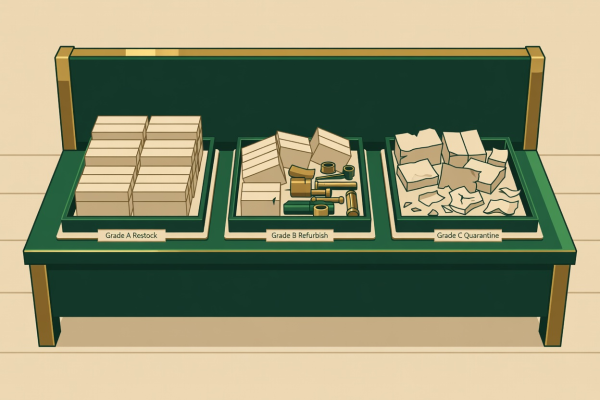
Flat vector illustration in forest green, brass, and parchment showing a returns intake bench with Grade A Restock, Grade B Refurbish, and Grade C Quarantine trays

Make the Return Easy to Identify Before It Arrives

The fastest way to slow down returns processing is receiving a brown box with no paperwork inside and an illegible handwritten sender name on the outside. Build return traceability into your outbound parcel before it ever leaves the bench.

Outbound Preparation

Barcode Every Dispatch Note & Outer Label

Print a Code-128 barcode of the order number (e.g., #PM-10482) at the bottom of your paper packing slip and inside the reference field of the outbound 4×6 label. Even if the customer forgets to include the slip, scanning or reading the RMA reference printed on the portal return label pulls up the exact order on screen in two seconds.

Packaging Reuse

Double Tear-Strip Cartons & Mailers

When selling size-sensitive apparel or footwear, use boxes or kraft mailers with a dual peel-and-seal adhesive strip and a perforated rip-strip. Customers can return the item in the exact same protective packaging rather than crushing a shoebox inside a thin supermarket carrier bag.

The 14:30 Returns Intake Routine

Never open incoming returns on the active packing bench while outbound labels are printing. Schedule a dedicated 30-minute window after the main morning wave—or use a separate 90 cm side table—equipped with three colour-coded polypropylene crates.

Step 1: Intake Scan & Seal Check

Slice open the return parcel using a ceramic safety cutter set to 4 mm depth so you never nick inner garments or retail boxes. Scan the RMA or order barcode to open the return record, and check that all original accessories, cables, or swing tags are present.

Step 2: Immediate Refund or Exchange Release

Once the item passes visual inspection, trigger the exchange order or refund immediately while the parcel is in your hands. Touching the same return twice—once to inspect and a second time on Friday to process accounts—doubles administrative labour.

The Three-Tray Grading & Disposition Matrix

Every item removed from a return parcel must go directly into one of three physical trays—never back onto the desk surface.

Tray Grade Physical Condition Criteria Bench Action Required Inventory System Status Target Turnaround
Grade A — Direct Restock Factory seal intact, unworn/unused, inner retail box pristine, barcode scannable. Wipe outer dust, place in Green Restock Tote for end-of-day put-away to primary bin. Increment Available / Sellable stock count immediately. Same day (within 4 hours of courier drop).
Grade B — Re-Box / Refurbish Product unused and flawless, but inner polybag torn, swing tag detached, or retail sleeve creased. Move to Brass Refurbish Tray; replace polybag, re-attach tag, or steam garment during Friday maintenance block. Hold in Quarantine / Work-in-Progress until re-bagged. Within 48 hours.
Grade C — Defective / Transit Damage Broken in transit, customer-damaged, missing components, or genuine manufacturing fault. Photograph item + outer carton box certificate for carrier claim; place in Red Seconds/Scrap Bin. Write off to Damaged / Seconds SKU; never add back to main SKU count. Logged immediately; weekly supplier/carrier claim batch.

Visit the Workshop Help Desk →